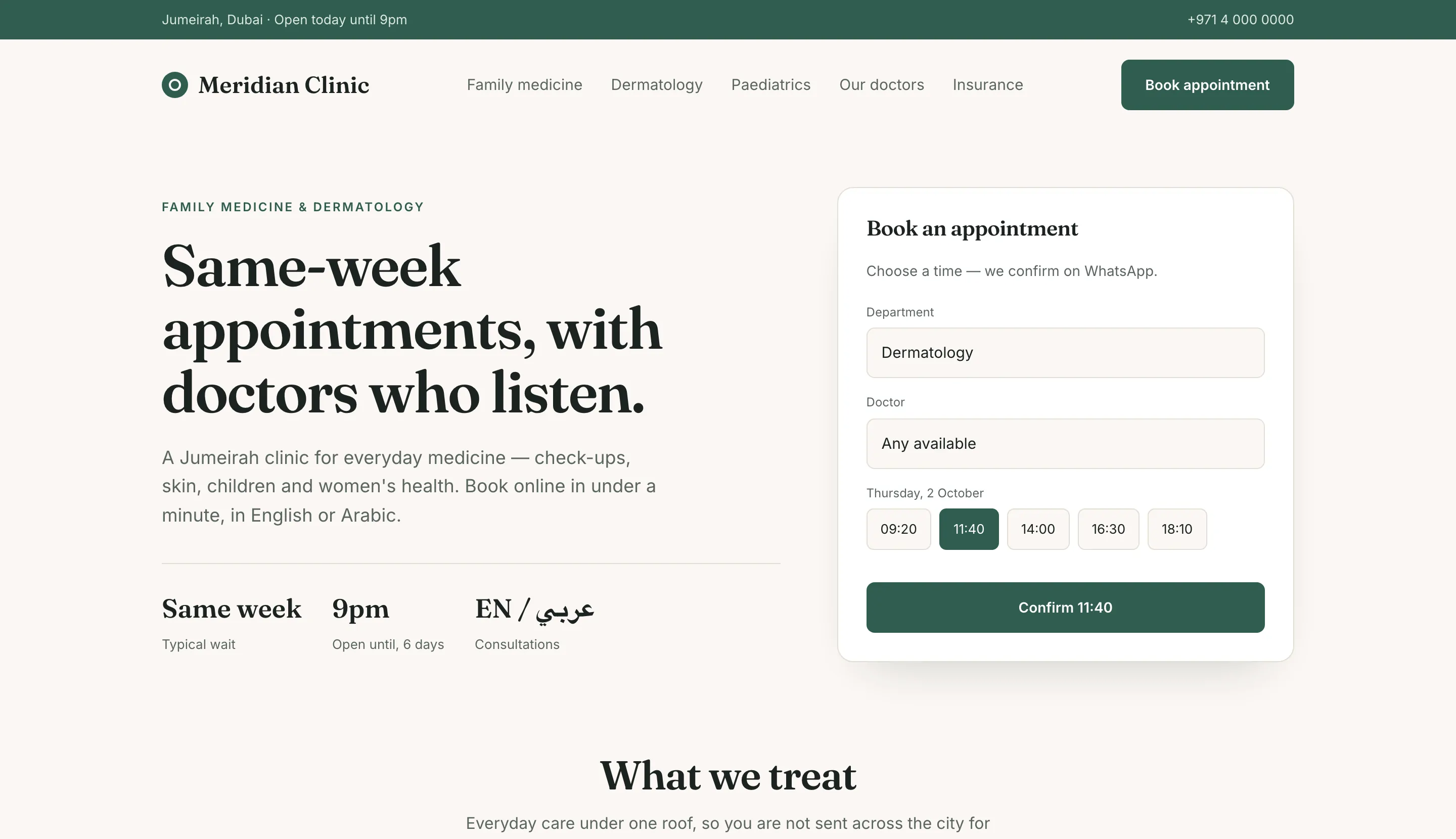
Online booking
Live availability by practitioner and treatment, confirmed by SMS.
Patients decide on their phone, at night, when nobody is answering reception. The site has to close for you.
Live availability by practitioner and treatment, confirmed by SMS.
What happens, how long it takes, what it costs — in both languages.
Google Business Profile, clinic schema and area pages.
Licences, practitioner profiles and real reviews where they count.
Your site gets a page for each of the things people actually type, instead of one homepage trying to rank for everything.
Most patients choose a clinic on their phone, often in the evening, after comparing two or three in other tabs. By the time they call, they have already decided who they trust. A clinic site has one job in that window: answer the questions that stop someone booking — what the treatment involves, who does it, roughly what it costs, and when they can come in — and then make booking the easiest thing on the page.
That sounds like any business site, but clinics carry two things most businesses do not: rules on what you can say about a treatment, and rules on where patient information is kept. Both shape the site from the first page design, so they are worth settling before anyone writes copy.
The Dubai Health Authority regulates health advertising by the facilities and professionals it licenses. Its standards for advertising on social media, reported in September 2026, list the claims it treats as misleading. Clinics licensed in Abu Dhabi or the northern emirates answer to their own regulator, but the same principles are a sensible floor. A website is where patients go after seeing a post, so the safest course is to hold it to the same rules.
What you can show is what patients actually want: clear facts about each treatment, contact details and opening hours, practitioners' approved qualifications and titles, and the facility's safety and quality accreditations. Written well, that reads as more trustworthy than superlatives ever did. If you are unsure whether a page needs approval, ask your regulator before it goes live; this page is a guide, not legal advice.
Federal Law No. 2 of 2019 governs how technology is used with health information across the UAE, free zones included. Article 13 says health data relating to health services provided in the UAE may not be stored, processed, generated or transferred outside the country unless a health authority or the Minister approves it. Article 20 requires health data to be kept for at least 25 years after the patient's last procedure.
For a website, the practical consequence is simple: be deliberate about what the site collects and where it goes. Many form and booking tools store submissions on servers abroad. The clean approach is for the website to ask only for what it needs to arrange a visit — name, contact details, the treatment and a preferred time — and to leave medical history and clinical notes to your practice system, kept where your licence requires. If you want full online booking, check where the booking provider holds the data before you choose it.
The enquiries a clinic loses are the ones that arrive when nobody can answer. There are three ways to catch them, in rising order of effort:
People search for the treatment, not the clinic: "teeth whitening", "laser hair removal", "physiotherapy", with an area or "near me". One page that lists everything cannot rank for all of them. A page per treatment can, and it is also where a patient's real questions get answered: what happens on the day, how long it takes, the recovery, who performs it, the risks, and a starting price if you are willing to show one. Where your patients search in Arabic, the treatment pages are the ones worth having in Arabic first.
Practitioner profiles do the rest of the trust work: a photo, approved qualifications and titles, languages spoken and the treatments each person performs. Paired with your Google Business Profile and genuine reviews, they are what moves a patient from comparing to booking.
A clinic site with a home page, a handful of treatment pages, practitioner profiles and WhatsApp or request-a-slot booking follows Brisk's usual two-week plan: design approved in week one, build and launch in week two. A large treatment library, Arabic versions of every page or live booking connected to your practice system take longer, and we agree that timeline before starting.
Brisk works to a fixed price agreed up front. For a sense of the market, see what a website costs in Dubai and what adding Arabic costs.
The DHA regulates health advertising by the facilities and professionals it licenses, and its standards rule out absolute claims, guarantees and comparisons with other providers. Whether a specific page needs approval before it goes live is a question for the DHA itself, so confirm with them for anything beyond factual service, contact and practitioner information.
Yes. The simplest options are a WhatsApp button on each treatment page or a short request-a-slot form that reception confirms. Live availability by practitioner is possible when your practice system or booking provider allows it, and that booking data has to be held in line with UAE health data rules.
It is better that it does not. UAE law restricts storing or processing health data outside the country, and many form tools store submissions abroad. Keep the website to what is needed to arrange a visit, and record clinical details in your practice system.
A clinic site with treatment pages, practitioner profiles and WhatsApp or request-a-slot booking usually launches in about two weeks. A large treatment library, full Arabic or live booking connected to a practice system takes longer, and the timeline is agreed before work starts.
Send us your current website or Instagram. We’ll send back a redesigned homepage within 2 working days, free and with no obligation.